
Why Andorra's tax system attracts so much interest
Andorra is one of Europe’s lowest-tax countries. Its fiscal advantages attract professionals, freelancers and businesses every year who want to optimise their tax burden without sacrificing quality of life or legal stability.
But beyond the headlines, the relevant question is concrete: how much do you actually pay, and what does the difference look like compared to countries like Spain, France or the United Kingdom?
Income tax in Andorra: structure and rates
Personal income tax in Andorra follows a progressive structure with three brackets: income up to €24,000 per year is taxed at 0%, income between €24,000 and €40,000 at 5%, and income above €40,000 at 10%.
- Income up to €24,000 per year: 0%
- Income between €24,000 and €40,000: 5%
- Income above €40,000: 10%
The maximum effective rate is 10%, well below the marginal rates of Spain (up to 47%), France (up to 45%) or the United Kingdom (up to 45%). Social contributions to the CASS must also be considered to calculate the total tax burden.
Social contributions: the CASS
In addition to income tax, residents contribute to the Caixa Andorrana de Seguretat Social (CASS), which covers health, retirement and social benefits.
Current rates are approximately 6% for employees and 15.5% for employers — significantly lower than the social security systems in Spain or France.
Andorra's fiscal advantages in perspective
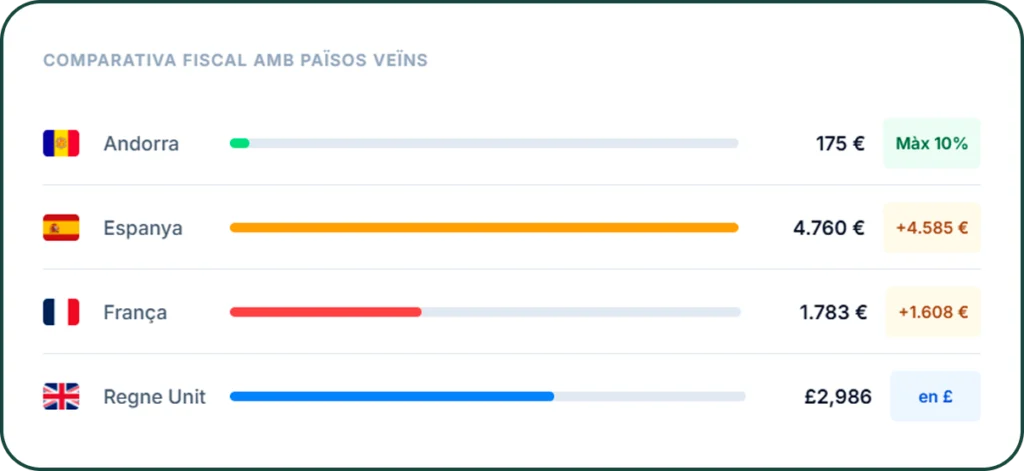
For a professional earning €60,000 gross per year, the total tax burden in Andorra can be two to three times lower than in Spain. At higher income levels, the gap widens considerably.
These fiscal advantages make Andorra particularly attractive for high-value professionals, freelancers and executives who meet the residency requirements: a minimum presence of 183 days per year in the Principality.
Calculate your actual tax situation
General figures are a guide, but every situation is different. That’s why we built a free calculator that compares the real total tax burden — income tax and social contributions included — between Andorra, Spain, France and the United Kingdom.
Access the free calculator
If you operate in Andorra, payroll management changes too
Working or hiring in Andorra means correctly applying CASS regulations and Andorran income tax in every payroll. AndNom is ProgDev’s software designed for exactly this: it automates the calculation, applies current legislation and generates all required documentation without manual data entry or errors.

Want to automate payroll and tax withholding management?
With AndNom, IRPF and payroll calculation is complete and automatic, integrating all employment variables and complying with current Andorran regulations.
Frequently asked questions
1. What are the income tax brackets in Andorra?
Personal income tax in Andorra applies three progressive brackets: income up to €24,000 per year is taxed at 0%, income between €24,000 and €40,000 at 5%, and income above €40,000 at 10%. The maximum effective rate is therefore 10%, well below the marginal rates of Spain (up to 47%), France (up to 45%) or the United Kingdom (up to 45%). Social contributions to the CASS must also be added to calculate the total tax burden.
2. What are the main tax advantages of moving your residence to Andorra?
Establishing tax residency in Andorra significantly reduces the income tax burden, with a maximum rate of 10% compared to typical European rates. In addition, Andorra does not apply wealth tax or inheritance and gift tax between direct family members, and the general corporate tax rate is also 10%. For high-value professionals, freelancers and executives, the combination of low taxation, legal stability and quality of life makes the Principality a particularly attractive option.
3. What requirements must be met to become a tax resident in Andorra?
To obtain Andorran tax residency, you must prove a minimum presence of 183 days per year in the Principality, have a property or rental agreement, and demonstrate economic or professional ties to the country. There are different types of residency: employed, self-employed, passive investment and family ties — each with its own specific requirements. It is advisable to seek advice from a professional specialised in Andorran taxation before starting the process.
4. How does the tax burden compare between Andorra and Spain?
For the same income, the difference in total tax burden between Andorra and Spain is substantial. A professional earning €60,000 gross per year would pay approximately €175 in income tax in Andorra, compared to around €4,760 in Spain, not including the difference in social contributions. At higher income levels, the gap widens considerably. This difference explains why many Spanish professionals consider relocating to the Principality as a strategic rather than purely logistical decision.
5. Are there digital tools to manage income tax and payroll in Andorra?
Yes. Managing payroll in Andorra requires correctly applying Andorran income tax brackets and CASS contributions, under a specific regulatory framework different from Spain or France. AndNom is ProgDev's software designed for companies operating in the Principality: it automates payroll calculation, applies current legislation and generates all required documentation without manual data entry. To get an indicative estimate of your personal tax burden, you can use our free income tax and social contributions calculator.
6. Is Andorra a tax haven? Reality vs myth
Andorra does not appear on the European Union's or the OECD's lists of tax havens. The Principality has signed numerous tax information exchange agreements and meets international transparency standards. What it does offer is a legally favourable tax system: low tax rates, the absence of certain taxes found in other European countries, and a stable regulatory framework. The distinction matters: a competitive and transparent tax system is not the same as fiscal opacity. Relocating to Andorra is a legal decision and an increasingly common one among European professionals.